The Case for Going Analog: Building a Personal Safety Net That Doesn't Depend on Your Phone
Let's be direct about something the personal safety technology industry rarely acknowledges: your smartphone will fail you at some point. The battery will die during a long hike. The cell signal will drop in the rural stretch of highway where your car breaks down. The app will crash, the server will time out, or the emergency notification will simply not send. These are not hypothetical edge cases. They are documented, recurring realities that users across the country encounter regularly.
This is not an argument against safety apps. The best digital tools offer genuine, meaningful protection that no analog system can fully replicate. But the assumption that technology is always the superior solution—and that offline alternatives are merely quaint relics—leaves people dangerously unprepared for the moments when technology fails.
Building a personal safety system that functions independently of your phone is not a rejection of modern tools. It is the completion of them.
Why the Buddy System Deserves More Credit
The buddy system has been dismissed as a concept for summer camps and school field trips, but its underlying logic is sound and its applications extend well into adult life. At its core, the buddy system is simply a mutual accountability agreement: someone specific knows where you are going, when you expect to arrive, and what to do if they do not hear from you.
The critical word is specific. A vague sense among your social circle that you were heading somewhere this weekend is not a buddy system. An explicit arrangement with one designated person—who has your itinerary, your expected check-in times, and clear instructions about when and how to escalate concern—is.
For solo travelers, hikers, runners, and anyone whose routine regularly takes them to isolated or unfamiliar environments, identifying a consistent safety contact and establishing clear expectations with that person is one of the highest-impact safety decisions available. No download required.
Designing a Check-In Protocol That Actually Works
The most common failure point in informal check-in arrangements is ambiguity. People agree to "stay in touch" without defining what that means, and when communication lapses, neither party is certain whether concern is warranted.
A functional check-in protocol eliminates ambiguity through specificity. Consider the following framework:
Establish fixed check-in times. Rather than agreeing to check in "when you get there," set explicit times. If you are driving from Chicago to Nashville, you might agree to check in at 2:00 PM from a rest stop near Indianapolis and again at 6:00 PM upon arrival. Fixed times create clear expectations and make a missed check-in immediately recognizable.
Define the escalation threshold. Your safety contact needs to know at exactly what point a missed check-in becomes cause for action—and what that action looks like. Is it a phone call? A text? Contacting local authorities? Reaching out to someone at your destination? Spell this out in advance, because asking someone to make that judgment call in a moment of uncertainty is an unfair and unreliable approach.
Provide a written itinerary. Leave a physical or digital document with your safety contact that includes your planned route, any stops, your vehicle description and license plate if applicable, and the names and contact information of anyone you plan to meet. This information becomes critical if emergency responders need to be briefed quickly.
Coded Phrases and Discreet Communication
There are situations in which a person may be in danger but unable to communicate openly—a ride-share vehicle that feels unsafe, a social situation that has become threatening, or a location where making a distress call would escalate rather than resolve the problem.
Pre-established coded communication phrases address this scenario without requiring any technology beyond a basic text message or phone call.
The concept is simple: agree in advance on a phrase that sounds innocuous to an outside observer but signals to your contact that you need help. Variations of this idea have circulated in personal safety communities for years. A text saying "Did you feed the cat?" to a contact who knows you do not own a cat can trigger a predetermined response—a callback that gives you a reason to step away, a wellness check request to local police, or simply a record that something was wrong at a specific time.
The effectiveness of any coded phrase system depends entirely on prior agreement and clarity. Both parties must understand the signal, the appropriate response, and the threshold for escalating to emergency services.
Offline Navigation and Situational Awareness
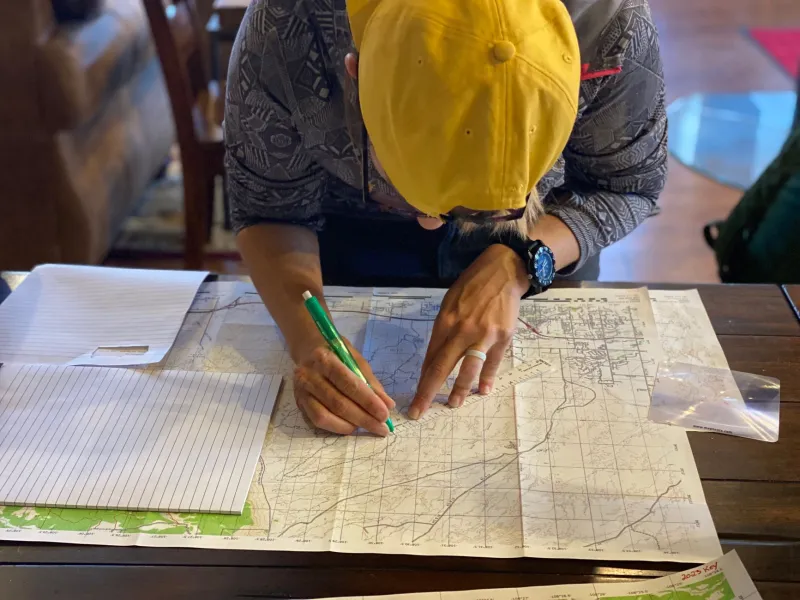
Beyond communication protocols, offline safety includes practical preparedness for navigation and environmental awareness. A printed map of an unfamiliar city or trail system is not a nostalgic affectation—it is a functional backup when GPS fails or a phone battery runs out.
For travelers heading to remote areas, a personal locator beacon (PLB) or satellite communicator such as a Garmin inReach device operates entirely independently of cellular networks. These devices are not apps; they are dedicated hardware tools that can summon search and rescue services from locations where no phone signal exists. For backcountry hikers, solo road-trippers crossing rural states, and international travelers venturing off established tourist infrastructure, they represent a category of protection that no smartphone app can match.
The Connectivity Gap Is Real
For a significant portion of the American population, unreliable cellular connectivity is not an occasional inconvenience—it is a daily condition. Rural communities across the Midwest, Appalachia, and the Mountain West regularly experience coverage gaps that render data-dependent safety apps nonfunctional. Travelers passing through these regions cannot assume that a safety app will perform as expected.
In these contexts, offline protocols are not a fallback. They are the primary system.
Complementing Digital Tools, Not Replacing Them
The most resilient personal safety approach is layered. A well-configured safety app provides real-time monitoring, rapid emergency response, and features that no human buddy system can replicate. An offline protocol provides a reliable foundation that functions regardless of battery life, signal strength, or server availability.
Think of the relationship between these two approaches the way a thoughtful traveler thinks about travel insurance: you hope you will never need the backup, but you are grateful for it when circumstances change unexpectedly.
At GetSafe, we are committed to building tools that genuinely protect people in the real world—and the real world includes dead zones, dead batteries, and the full range of situations where the most sophisticated app in the world is simply not available. Knowing how to protect yourself when the screen goes dark is not a limitation of personal safety technology. It is a completion of it.